Author Archive
The sweetest blossoms die.
And so it was that, going day by day
Unto the church to praise and pray,
And crossing the green churchyard thoughtfully,
I saw how on the graves the flowers
Shed their fresh leaves in showers,
And how their perfume rose up to the sky
Before it passed away.
The youngest blossoms die.
They die and fall and nourish the rich earth
From which they lately had their birth;
Sweet life, but sweeter death that passeth by
And is as though it had not been:—
All colors turn to green;
The bright hues vanish and the odors fly,
The grass hath lasting worth.
And youth and beauty die.
So be it, O my God, Thou God of truth:
Better than beauty and than youth
Are Saints and Angels, a glad company;
And Thou, O Lord, our Rest and Ease,
Art better far than these.
Why should we shrink from our full harvest? why
Prefer to glean with Ruth?
 No Comments »

Does the road wind up-hill all the way?
Yes, to the very end.
Will the day’s journey take the whole long day?
From morn to night, my friend.
But is there for the night a resting-place?
A roof for when the slow dark hours begin.
May not the darkness hide it from my face?
You cannot miss that inn.
Shall I meet other wayfarers at night?
Those who have gone before.
Then must I knock, or call when just in sight?
They will not keep you standing at that door.
Shall I find comfort, travel-sore and weak?
Of labor you shall find the sum.
Will there be beds for me and all who seek?
Yea, beds for all who come.
No Comments »
When I was dead, my spirit turned
To seek the much-frequented house:
I passed the door, and saw my friends
Feasting beneath green orange boughs;
From hand to hand they pushed the wine,
They sucked the pulp of plum and peach;
They sang, they jested, and they laughed,
For each was loved of each.
I listened to thier honest chat:
Said one: “To-morrow we shall be
Plod plod along the featureless sands,
And coasting miles and miles of sea.”
Said one: “Before the turn of tide
We will achieve the eyrie-seat.”
Said one: “To-morrow shall be like
To-day, but much more sweet.”
“To-morrow,” said they, strong with hope,
And dwelt upon the pleasant way:
“To-morrow,” cried they, one and all,
While no one spoke of yesterday.
Their life stood full at blessed noon;
I, only I, had passed away:
“To-morrow and to-day,” they cried;
I was of yesterday.
I shivered comfortless, but cast
No chill across the table-cloth;
I, all-forgotten, shivered, sad
To stay, and yet to part how loth:
I passed from the familiar room,
I who from love had passed away,
Like the remembrance of a guest
That tarrieth but a day.
No Comments »
There’s blood between us, love, my love,
There’s father’s blood, there’s brother’s blood;
And blood’s a bar I cannot pass:
I choose the stairs that mount above,
Stair after golden skyward stair,
To city and to sea of glass.
My lily feet are soiled with mud,
With scarlet mud which tells a tale
Of hope that was, of guilt that was,
Of love that shall not yet avail;
Alas, my heart, if I could bare
My heart, this selfsame stain is there:
I seek the sea of glass and fire
To wash the spot, to burn the snare;
Lo, stairs are meant to lift us higher:
Mount with me, mount the kindled stair.
Your eyes look earthward, mine look up.
I see the far-off city grand,
Beyond the hills a watered land,
Beyond the gulf a gleaming strand
Of mansions where the righteous sup;
Who sleep at ease among their trees,
Or wake to sing a cadenced hymn
With Cherubim and Seraphim;
They bore the Cross, they drained the cup,
Racked, roasted, crushed, wrenched limb from limb,
They the offscouring of the world:
The heaven of starry heavens unfurled,
The sun before their face is dim.
You looking earthward what see you?
Milk-white wine-flushed among the vines,
Up and down leaping, to and fro,
Most glad, most full, made strong with wines,
Blooming as peaches pearled with dew,
Their golden windy hair afloat,
Love-music warbling in their throat,
Young men and women come and go.
You linger, yet the time is short:
Flee for your life, gird up your strength
To flee; the shadows stretched at length
Show that day wanes, that night draws nigh;
Flee to the mountain, tarry not.
Is this a time for smile and sigh,
For songs among the secret trees
Where sudden blue birds nest and sport?
The time is short and yet you stay:
To-day while it is called to-day
Kneel, wrestle, knock, do violence, pray;
To-day is short, to-morrow nigh:
Why will you die? why will you die?
You sinned with me a pleasant sin:
Repent with me, for I repent.
Woe’s me the lore I must unlearn!
Woe’s me that easy way we went,
So rugged when I would return!
How long until my sleep begin,
How long shall stretch these nights and days?
Surely, clean Angels cry, she prays;
She laves her soul with tedious tears:
How long must stretch these years and years?
I turn from you my cheeks and eyes,
My hair which you shall see no more–
Alas for joy that went before,
For joy that dies, for love that dies.
Only my lips still turn to you,
My livid lips that cry, Repent.
Oh weary life, oh weary Lent,
Oh weary time whose stars are few.
How should I rest in Paradise,
Or sit on steps of heaven alone?
If Saints and Angels spoke of love
Should I not answer from my throne:
Have pity upon me, ye my friends,
For I have heard the sound thereof:
Should I not turn with yearning eyes,
Turn earthwards with a pitiful pang?
Oh save me from a pang in heaven.
By all the gifts we took and gave,
Repent, repent, and be forgiven:
This life is long, but yet it ends;
Repent and purge your soul and save:
No gladder song the morning stars
Upon their birthday morning sang
Than Angels sing when one repents.
I tell you what I dreamed last night:
A spirit with transfigured face
Fire-footed clomb an infinite space.
I heard his hundred pinions clang,
Heaven-bells rejoicing rang and rang,
Heaven-air was thrilled with subtle scents,
Worlds spun upon their rushing ears:
He mounted shrieking: ‘Give me light.’
Still light was poured on him, more light;
Angels, Archangels he outstripped
Exultant in exceeding might,
And trod the skirts of Cherubim.
Still ‘Give me light,’ he shrieked; and dipped
His thirsty face, and drank a sea,
Athirst with thirst it could not slake.
I saw him, drunk with knowledge, take
From aching brows the aureole crown–
His locks writhed like a cloven snake–
He left his throne to grovel down
And lick the dust of Seraph’s feet:
For what is knowledge duly weighed?
Knowledge is strong, but love is sweet;
Yea all the progress he had made
Was but to learn that all is small
Save love, for love is all in all.
I tell you what I dreamed last night:
It was not dark, it was not light,
Cold dews had drenched my plenteous hair
Through clay; you came to seek me there.
And ‘Do you dream of me?’ you said.
My heart was dust that used to leap
To you; I answered half asleep:
‘My pillow is damp, my sheets are red,
There’s a leaden tester to my bed:
Find you a warmer playfellow,
A warmer pillow for your head,
A kinder love to love than mine.’
You wrung your hands; while I like lead
Crushed downwards through the sodden earth:
You smote your hands but not in mirth,
And reeled but were not drunk with wine.
For all night long I dreamed of you:
I woke and prayed against my will,
Then slept to dream of you again.
At length I rose and knelt and prayed:
I cannot write the words I said,
My words were slow, my tears were few;
But through the dark my silence spoke
Like thunder. When this morning broke,
My face was pinched, my hair was grey,
And frozen blood was on the sill
Where stifling in my struggle I lay.
If now you saw me you would say:
Where is the face I used to love?
And I would answer: Gone before;
It tarries veiled in paradise.
When once the morning star shall rise,
When earth with shadow flees away
And we stand safe within the door,
Then you shall lift the veil thereof.
Look up, rise up: for far above
Our palms are grown, our place is set;
There we shall meet as once we met
And love with old familiar love.
No Comments »
Till all sweet gums and juices flow,
Till the blossom of blossoms blow,
The long hours go and come and go,
The bride she sleepeth, waketh, sleepeth,
Waiting for one whose coming is slow:—
Hark! the bride weepeth.
‘How long shall I wait, come heat come rime?’—
‘Till the strong Prince comes, who must come in time’
(Her women say), ‘there’s a mountain to climb,
A river to ford. Sleep, dream and sleep;
Sleep’ (they say): ‘we’ve muffled the chime,
Better dream than weep.’
In his world-end palace the strong Prince sat,
Taking his ease on cushion and mat,
Close at hand lay his staff and his hat.
‘When wilt thou start? the bride waits, O youth.’—
‘Now the moon’s at full; I tarried for that,
Now I start in truth.
‘But tell me first, true voice of my doom,
Of my veiled bride in her maiden bloom;
Keeps she watch through glare and through gloom,
Watch for me asleep and awake?’—
‘Spell-bound she watches in one white room,
And is patient for thy sake.
‘By her head lilies and rosebuds grow;
The lilies droop, will the rosebuds blow?
The silver slim lilies hang the head low;
Their stream is scanty, their sunshine rare:
Let the sun blaze out, and let the stream flow,
They will blossom and wax fair.
‘Red and white poppies grow at her feet,
The blood-red wait for sweet summer heat,
Wrapped in bud-coats hairy and neat;
But the white buds swell, one day they will burst,
Will open their death-cups drowsy and sweet—
Which will open the first?’
Then a hundred sad voices lifted a wail,
And a hundred glad voices piped on the gale:
‘Time is short, life is short,’ they took up the tale:
‘Life is sweet, love is sweet, use to-day while you may;
Love is sweet, and to-morrow may fail;
Love is sweet, use to-day.’
While the song swept by, beseeching and meek,
Up rose the Prince with a flush on his cheek,
Up he rose to stir and to seek,
Going forth in the joy of his strength;
Strong of limb if of purpose weak,
Starting at length.
Forth he set in the breezy morn,
Crossing green fields of nodding corn,
As goodly a Prince as ever was born;
Carolling with the carolling lark;—
Sure his bride will be won and worn,
Ere fall of the dark.
So light his step, so merry his smile,
A milkmaid loitered beside a stile,
Set down her pail and rested awhile,
A wave-haired milkmaid, rosy and white;
The Prince, who had journeyed at least a mile,
Grew athirst at the sight.
‘Will you give me a morning draught?’—
‘You’re kindly welcome,’ she said, and laughed.
He lifted the pail, new milk he quaffed;
Then wiping his curly black beard like silk:
‘Whitest cow that ever was calved
Surely gave you this milk.’
Was it milk now, or was it cream?
Was she a maid, or an evil dream?
Here eyes began to glitter and gleam;
He would have gone, but he stayed instead;
Green they gleamed as he looked in them:
‘Give me my fee,’ she said.—
‘I will give you a jewel of gold.’—
‘Not so; gold is heavy and cold.’—
‘I will give you a velvet fold
Of foreign work your beauty to deck.’—
‘Better I like my kerchief rolled
Light and white round my neck.’—
‘Nay,’ cried he, ‘but fix your own fee.’—
She laughed, ‘You may give the full moon to me;
Or else sit under this apple-tree
Here for one idle day by my side;
After that I’ll let you go free,
And the world is wide.’
Loth to stay, but to leave her slack,
He half turned away, then he quite turned back:
For courtesy’s sake he could not lack
To redeem his own royal pledge;
Ahead too the windy heaven lowered black
With a fire-cloven edge.
So he stretched his length in the apple-tree shade,
Lay and laughed and talked to the maid,
Who twisted her hair in a cunning braid
And writhed it shining in serpent-coils,
And held him a day and night fast laid
In her subtle toils.
At the death of night and the birth of day,
When the owl left off his sober play,
And the bat hung himself out of the way,
Woke the song of mavis and merle,
And heaven put off its hodden grey
For mother-o’-pearl.
Peeped up daisies here and there,
Here, there, and everywhere;
Rose a hopeful lark in the air,
Spreading out towards the sun his breast;
While the moon set solemn and fair
Away in the West.
‘Up, up, up,’ called the watchman lark,
In his clear réveillée: ‘Hearken, oh hark!
Press to the high goal, fly to the mark.
Up, O sluggard, new morn is born;
If still asleep when the night falls dark,
Thou must wait a second morn.’
‘Up, up, up,’ sad glad voices swelled:
‘So the tree falls and lies as it’s felled.
Be thy bands loosed, O sleeper, long held
In sweet sleep whose end is not sweet.
Be the slackness girt and the softness quelled
And the slowness fleet.’
Off he set. The grass grew rare,
A blight lurked in the darkening air,
The very moss grew hueless and spare,
The last daisy stood all astunt;
Behind his back the soil lay bare,
But barer in front.
A land of chasm and rent, a land
Of rugged blackness on either hand:
If water trickled its track was tanned
With an edge of rust to the chink;
If one stamped on stone or on sand
It returned a clink.
A lifeless land, a loveless land,
Without lair or nest on either hand:
Only scorpions jerked in the sand,
Black as black iron, or dusty pale;
From point to point sheer rock was manned
By scorpions in mail.
A land of neither life nor death,
Where no man buildeth or fashioneth,
Where none draws living or dying breath;
No man cometh or goeth there,
No man doeth, seeketh, saith,
In the stagnant air.
Some old volcanic upset must
Have rent the crust and blackened the crust;
Wrenched and ribbed it beneath its dust
Above earth’s molten centre at seethe,
Heaved and heaped it by huge upthrust
Of fire beneath.
Untrodden before, untrodden since:
Tedious land for a social Prince;
Halting, he scanned the outs and ins,
Endless, labyrinthine, grim,
Of the solitude that made him wince,
Laying wait for him.
By bulging rock and gaping cleft,
Even of half mere daylight reft,
Rueful he peered to right and left,
Muttering in his altered mood:
‘The fate is hard that weaves my weft,
Though my lot be good.’
Dim the changes of day to night,
Of night scarce dark to day not bright.
Still his road wound towards the right,
Still he went, and still he went,
Till one night he espied a light,
In his discontent.
Out it flashed from a yawn-mouthed cave,
Like a red-hot eye from a grave.
No man stood there of whom to crave
Rest for wayfarer plodding by:
Though the tenant were churl or knave
The Prince might try.
In he passed and tarried not,
Groping his way from spot to spot,
Towards where the cavern flare glowed hot:—
An old, old mortal, cramped and double,
Was peering into a seething-pot,
In a world of trouble.
The veriest atomy he looked,
With grimy fingers clutching and crooked,
Tight skin, a nose all bony and hooked,
And a shaking, sharp, suspicious way;
His blinking eyes had scarcely brooked
The light of day.
Stared the Prince, for the sight was new;
Stared, but asked without more ado:
‘My a weary traveller lodge with you,
Old father, here in your lair?
In your country the inns seem few,
And scanty the fare.’
The head turned not to hear him speak;
The old voice whistled as through a leak
(Out it came in a quavering squeak):
‘Work for wage is a bargain fit:
If there’s aught of mine that you seek
You must work for it.
‘Buried alive from light and air
This year is the hundredth year,
I feed my fire with a sleepless care,
Watching my potion wane or wax:
Elixir of Life is simmering there,
And but one thing lacks.
‘If you’re fain to lodge here with me,
Take that pair of bellows you see—
Too heavy for my old hands they be—
Take the bellows and puff and puff:
When the steam curls rosy and free
The broth’s boiled enough.
‘Then take your choice of all I have;
I will give you life if you crave.
Already I’m mildewed for the grave,
So first myself I must drink my fill:
But all the rest may be yours, to save
Whomever you will.’
‘Done,’ quoth the Prince, and the bargain stood,
First he piled on resinous wood,
Next plied the bellows in hopeful mood;
Thinking, ‘My love and I will live.
If I tarry, why life is good,
And she may forgive.’
The pot began to bubble and boil;
The old man cast in essence and oil,
He stirred all up with a triple coil
Of gold and silver and iron wire,
Dredged in a pinch of virgin soil,
And fed the fire.
But still the steam curled watery white;
Night turned to day and day to night;
One thing lacked, by his feeble sight
Unseen, unguessed by his feeble mind:
Life might miss him, but Death the blight
Was sure to find.
So when the hundredth year was full
The thread was cut and finished the school.
Death snapped the old worn-out tool,
Snapped him short while he stood and stirred
(Though stiff he stood as a stiff-necked mule)
With never a word.
Thus at length the old crab was nipped.
The dead hand slipped, the dead finger dipped
In the broth as the dead man slipped,—
That same instant, a rosy red
Flushed the steam, and quivered and clipped
Round the dead old head.
The last ingredient was supplied
(Unless the dead man mistook or lied).
Up started the Prince, he cast aside
The bellows plied through the tedious trial,
Made sure that his host had died,
And filled a phial.
‘One night’s rest,’ though the Prince: ‘This done,
Forth I start with the rising sun:
With the morrow I rise and run,
Come what will of wind or of weather.
This draught of Life when my Bride is won
We’ll drink together.’
Thus the dead man stayed in his grave,
Self-chosen, the dead man in his cave;
There he stayed, were he fool or knave,
Or honest seeker who had not found:
While the Prince outside was prompt to crave
Sleep on the ground.
‘If she watches, go bid her sleep;
Bit her sleep, for the road is steep:
He can sleep who holdeth her cheap,
Sleep and wake and sleep again.
Let him sow, one day he shall reap,
Let him sow the grain.
‘When there blows a sweet garden rose,
Let it bloom and wither if no man knows:
But if one knows when the sweet thing blows,
Knows, and lets it open and drop,
If but a nettle his garden grows
He hath earned the crop.’
Through his sleep the summons rang,
Into his ears it sobbed and it sang.
Slow he woke with a drowsy pang,
Shook himself without much debate,
Turned where he saw green branches hang,
Started though late.
For the black land was travelled o’er,
He should see the grim land no more.
A flowering country stretched before
His face when the lovely day came back:
He hugged the phial of Life he bore,
And resumed his track.
By willow courses he took his path,
Spied what a nest the kingfisher hath,
Marked the fields green to aftermath,
Marked where the red-brown field-mouse ran,
Loitered a while for a deep-stream bath,
Yawned for a fellow-man.
Up on the hills not a soul in view,
In a vale not many nor few;
Leaves, still leaves, and nothing new.
It’s oh for a second maiden, at least,
To bear the flagon, and taste it too,
And flavour the feast.
Lagging he moved, and apt to swerve;
Lazy of limb, but quick of nerve.
At length the water-bed took a curve,
The deep river swept its bankside bare;
Waters streamed from the hill-reserve—
Waters here, waters there.
High above, and deep below,
Bursting, bubbling, swelling the flow,
Like hill torrents after the snow,—
Bubbling, gurgling, in whirling strife,
Swaying, sweeping, to and fro,—
He must swim for his life.
Which way?—which way?—his eyes grew dim
With the dizzying whirl—which way to swim?
The thunderous downshoot deafened him;
Half he choked in the lashing spray:
Life is sweet, and the grave is grim—
Which way?—which way?
A flash of light, a shout from the strand:
‘This way—this way; here lies the land!’
His phial clutched in one drowning hand;
He catches—misses—catches a rope;
His feet slip on the slipping sand:
Is there life?—is there hope?
Just saved, without pulse or breath,—
Scarcely saved from the gulp of death;
Laid where a willow shadoweth—
Laid where a swelling turf is smooth.
(O Bride! but the Bridegroom lingereth
For all thy sweet youth.)
Kind hands do and undo,
Kind voices whisper and coo:
‘I will chafe his hands’—’And I’—’And you
Raise his head, put his hair aside.’
(If many laugh, one well may rue:
Sleep on, thou Bride.)
So the Prince was tended with care:
One wrung foul ooze from his clustered hair;
Two chafed his hands, and did not spare;
But one held his drooping head breast-high,
Till his eyes oped, and at unaware
They met eye to eye.
Oh, a moon face in a shadowy place,
And a light touch and a winsome grace,
And a thrilling tender voice that says:
‘Safe from waters that seek the sea—
Cold waters by rugged ways—
Safe with me.’
While overhead bird whistles to bird,
And round about plays a gamesome herd:
‘Safe with us’—some take up the word—
‘Safe with us, dear lord and friend:
All the sweeter if long deferred
Is rest in the end.’
Had he stayed to weigh and to scan,
He had been more or less than a man:
He did what a young man can,
Spoke of toil and an arduous way—
Toil to-morrow, while golden ran
The sands of to-day.
Slip past, slip fast,
Uncounted hours from first to last,
Many hours till the last is past,
Many hours dwindling to one—
One hour whose die is cast,
One last hour gone.
Come, gone—gone for ever—
Gone as an unreturning river—
Gone as to death the merriest liver—
Gone as the year at the dying fall—
To-morrow, to-day, yesterday, never—
Gone once for all.
Came at length the starting-day,
With last words, and last words to say,
With bodiless cries from far away—
Chiding wailing voices that rang
Like a trumpet-call to the tug and fray;
And thus they sang:
‘Is there life?—the lamp burns low;
Is there hope?—the coming is slow:
The promise promised so long ago,
The long promise, has not been kept.
Does she live?—does she die?—she slumbers so
Who so oft has wept.
‘Does she live?—does she die?—she languisheth
As a lily drooping to death,
As a drought-worn bird with failing breath,
As a lovely vine without a stay,
As a tree whereof the owner saith,
“Hew it down to-day.”‘
Stung by that word the Prince was fain
To start on his tedious road again.
He crossed the stream where a ford was plain,
He clomb the opposite bank though steep,
And swore to himself to strain and attain
Ere he tasted sleep.
Huge before him a mountain frowned
With foot of rock on the valley ground,
And head with snows incessant crowned,
And a cloud mantle about its strength,
And a path which the wild goat hath not found
In its breadth and length.
But he was strong to do and dare:
If a host had withstood him there,
He had braved a host with little care
In his lusty youth and his pride,
Tough to grapple though weak to snare.
He comes, O Bride.
Up he went where the goat scarce clings,
Up where the eagle folds her wings,
Past the green line of living things,
Where the sun cannot warm the cold,—
Up he went as a flame enrings
Where there seems no hold.
Up a fissure barren and black,
Till the eagles tired upon his track,
And the clouds were left behind his back,
Up till the utmost peak was past,
Then he gasped for breath and his strength fell slack;
He paused at last.
Before his face a valley spread
Where fatness laughed, wine, oil, and bread,
Where all fruit-trees their sweetness shed,
Where all birds made love to their kind,
Where jewels twinkled, and gold lay red
And not hard to find.
Midway down the mountain side
(On its green slope the path was wide)
Stood a house for a royal bride,
Built all of changing opal stone,
The royal palace, till now descried
In his dreams alone.
Less bold than in days of yore,
Doubting now though never before,
Doubting he goes and lags the more:
Is the time late? does the day grow dim?
Rose, will she open the crimson core
Of her heart to him?
Take heart of grace! the potion of Life
May go far to woo him a wife:
If she frown, yet a lover’s strife
Lightly raised can be laid again:
A hasty word is never the knife
To cut love in twain.
Far away stretched the royal land,
Fed by dew, by a spice-wind fanned:
Light labour more, and his foot would stand
On the threshold, all labour done;
Easy pleasure laid at his hand,
And the dear Bride won.
His slackening steps pause at the gate—
Does she wake or sleep?—the time is late—
Does she sleep now, or watch and wait?
She has watched, she has waited long,
Watching athwart the golden grate
With a patient song.
Fling the golden portals wide,
The Bridegroom comes to his promised Bride;
Draw the gold-stiff curtains aside,
Let them look on each other’s face,
She in her meekness, he in his pride—
Day wears apace.
Day is over, the day that wore.
What is this that comes through the door,
The face covered, the feet before?
This that coming takes his breath;
The Bride not seen, to be seen no more
Save of Bridegroom Death?
Veiled figures carrying her
Sweep by yet make no stir;
There is a smell of spice and myrrh,
A bride-chant burdened with one name;
The bride-song rises steadier
Than the torches’ flame:
‘Too late for love, too late for joy,
Too late, too late!
You loitered on the road too long,
You trifled at the gate:
The enchanted dove upon her branch
Died without a mate;
The enchanted princess in her tower
Slept, died, behind the grate;
Her heart was starving all this while
You made it wait.
‘Ten years ago, five years ago,
One year ago,
Even then you had arrived in time,
Though somewhat slow;
Then you had known her living face
Which now you cannot know:
The frozen fountain would have leaped,
The buds gone on to blow,
The warm south wind would have awaked
To melt the snow.
‘Is she fair now as she lies?
Once she was fair;
Meet queen for any kingly king,
With gold-dust on her hair.
Now these are poppies in her locks,
White poppies she must wear;
Must wear a veil to shroud her face
And the want graven there:
Or is the hunger fed at length,
Cast off the care?
‘We never saw her with a smile
Or with a frown;
Her bed seemed never soft to her,
Though tossed of down;
She little heeded what she wore,
Kirtle, or wreath, or gown;
We think her white brows often ached
Beneath her crown,
Till silvery hairs showed in her locks
That used to be so brown.
‘We never heard her speak in haste;
Her tones were sweet,
And modulated just so much
As it was meet:
Her heart sat silent through the noise
And concourse of the street.
There was no hurry in her hands,
No hurry in her feet;
There was no bliss drew nigh to her,
That she might run to greet.
‘You should have wept her yesterday,
Wasting upon her bed:
But wherefore should you weep to-day
That she is dead?
Lo, we who love weep not to-day,
But crown her royal head.
Let be these poppies that we strew,
Your roses are too red:
Let be these poppies, not for you
Cut down and spread.’
No Comments »
I, a princess, king-descended, decked with jewels, gilded, drest,
Would rather be a peasant with her baby at her breast,
For all I shine so like the sun, and am purple like the west.
Two and two my guards behind, two and two before,
Two and two on either hand, they guard me evermore;
Me, poor dove, that must not coo—eagle that must not soar.
All my fountains cast up perfumes, all my gardens grow
Scented woods and foreign spices, with all flowers in blow
That are costly, out of season as the seasons go.
All my walls are lost in mirrors, whereupon I trace
Self to right hand, self to left hand, self in every place,
Self-same solitary figure, self-same seeking face.
Then I have an ivory chair high to sit upon,
Almost like my father’s chair, which is an ivory throne;
There I sit uplift and upright, there I sit alone.
Alone by day, alone by night, alone days without end;
My father and my mother give me treasures, search and spend—
O my father! O my mother! have you ne’er a friend?
As I am a lofty princess, so my father is
A lofty king, accomplished in all kingly subtilties,
Holding in his strong right hand world-kingdoms’ balances.
He has quarrelled with his neighbours, he has scourged his foes;
Vassal counts and princes follow where his pennon goes,
Long-descended valiant lords whom the vulture knows,
On whose track the vulture swoops, when they ride in state
To break the strength of armies and topple down the great:
Each of these my courteous servant, none of these my mate.
My father counting up his strength sets down with equal pen
So many head of cattle, head of horses, head of men;
These for slaughter, these for breeding, with the how and when.
Some to work on roads, canals; some to man his ships;
Some to smart in mines beneath sharp overseers’ whips;
Some to trap fur-beasts in lands where utmost winter nips.
Once it came into my heart, and whelmed me like a flood,
That these too are men and women, human flesh and blood;
Men with hearts and men with souls, though trodden down like mud.
Our feasting was not glad that night, our music was not gay:
On my mother’s graceful head I marked a thread of grey,
My father frowning at the fare seemed every dish to weigh.
I sat beside them sole princess in my exalted place,
My ladies and my gentlemen stood by me on the dais:
A mirror showed me I look old and haggard in the face;
It showed me that my ladies all are fair to gaze upon,
Plump, plenteous-haired, to every one love’s secret lore is known,
They laugh by day, they sleep by night; ah me, what is a throne?
The singing men and women sang that night as usual,
The dancers danced in pairs and sets, but music had a fall,
A melancholy windy fall as at a funeral.
Amid the toss of torches to my chamber back we swept;
My ladies loosed my golden chain; meantime I could have wept
To think of some in galling chains whether they waked or slept.
I took my bath of scented milk, delicately waited on,
They burned sweet things for my delight, cedar and cinnamon,
They lit my shaded silver lamp, and left me there alone.
A day went by, a week went by. One day I heard it said:
‘Men are clamouring, women, children, clamouring to be fed;
Men like famished dogs are howling in the streets for bread.’
So two whispered by my door, not thinking I could hear,
Vulgar naked truth, ungarnished for a royal ear;
Fit for cooping in the background, not to stalk so near.
But I strained my utmost sense to catch this truth, and mark:
‘There are families out grazing like cattle in the park.’
‘A pair of peasants must be saved even if we build an ark.’
A merry jest, a merry laugh, each strolled upon his way;
One was my page, a lad I reared and bore with day by day;
One was my youngest maid as sweet and white as cream in May.
Other footsteps followed softly with a weightier tramp;
Voices said: ‘Picked soldiers have been summoned from the camp
To quell these base-born ruffians who make free to howl and stamp.’
‘Howl and stamp?’ one answered: ‘They made free to hurl a stone
At the minister’s state coach, well aimed and stoutly thrown.’
‘There’s work then for the soldiers, for this rank crop must be mown.’
‘One I saw, a poor old fool with ashes on his head,
Whimpering because a girl had snatched his crust of bread:
Then he dropped; when some one raised him, it turned out he was dead.’
‘After us the deluge,’ was retorted with a laugh:
‘If bread’s the staff of life, they must walk without a staff.’
‘While I’ve a loaf they’re welcome to my blessing and the chaff.’
These passed. The king: stand up. Said my father with a smile:
‘Daughter mine, your mother comes to sit with you awhile,
She’s sad to-day, and who but you her sadness can beguile?’
He too left me. Shall I touch my harp now while I wait,—
(I hear them doubling guard below before our palace gate—)
Or shall I work the last gold stitch into my veil of state;
Or shall my woman stand and read some unimpassioned scene,
There’s music of a lulling sort in words that pause between;
Or shall she merely fan me while I wait here for the queen?
Again I caught my father’s voice in sharp word of command:
‘Charge!’ a clash of steel: ‘Charge again, the rebels stand.
Smite and spare not, hand to hand; smite and spare not, hand to hand.’
There swelled a tumult at the gate, high voices waxing higher;
A flash of red reflected light lit the cathedral spire;
I heard a cry for faggots, then I heard a yell for fire.
‘Sit and roast there with your meat, sit and bake there with your bread,
You who sat to see us starve,’ one shrieking woman said:
‘Sit on your throne and roast with your crown upon your head.’
Nay, this thing will I do, while my mother tarrieth,
I will take my fine spun gold, but not to sew therewith,
I will take my gold and gems, and rainbow fan and wreath;
With a ransom in my lap, a king’s ransom in my hand,
I will go down to this people, will stand face to face, will stand
Where they curse king, queen, and princess of this cursed land.
They shall take all to buy them bread, take all I have to give;
I, if I perish, perish; they to-day shall eat and live;
I, if I perish, perish; that’s the goal I half conceive:
Once to speak before the world, rend bare my heart and show
The lesson I have learned which is death, is life, to know.
I, if I perish, perish; in the name of God I go.
No Comments »

When I am dead, my dearest,
Sing no sad songs for me;
Plant thou no roses at my head,
Nor shady cypress tree:
Be the green grass above me
With showers and dewdrops wet;
And if thou wilt, remember,
And if thou wilt, forget.
I shall not see the shadows,
I shall not feel the rain;
I shall not hear the nightingale
Sing on, as if in pain:
And dreaming through the twilight
That doth not rise nor set,
Haply I may remember,
And haply may forget.
No Comments »
FIRST PAPER
Subject: # 14217 Poesía Inglesa desde el siglo XVIII Grupo B
Student´s name: Mengual Roca , Vanessa
Title of the paper: A ’spinster’ who disguised her true personality and yearnings in verses.
Author or topic: Christina Rossetti
Abstract: In this paper I am going to analyze the true personality of Christina Georgina Rossetti (Ellen Alleyne). First of all, I have written an introduction to present the work I have carried out. I have offered a biography of the author for the reader to contextualize the poet and to have a knowledge about what type of life Christina Rossetti lived. After that, one of her most important works has been provided: ‘Goblin Market’ because starting from this poem I have come to understand her true personality. So, a strong relation between Goblin Market and her personality has been established and broken down in four parts called: A repressed sexuality; Christina Rossetti determined by education and Victorian morals but at the same time against it; Religion will prevail and Feminism, her dream. Lastly, the conclusion summarizes my impressions on the paper.
WEBLOGRAPHY URL’S
Auto-evaluation: I think I deserve a mark of 7, since I have chosen an interesting topic to the viewer, I have gone beyond Christina’s simple appearance and I have got me mixed up a lot in the poem’s feelings. As detailed as it is possible, this paper has been done.

Academic Year 2010/2011
©a.r.e.a./Dr.Vicente Forés López
©Vanessa Mengual Roca
vamenro@alumni.uv.es
No Comments »
Goblin Market
by Christina Rossetti
- MORNING and evening
- Maids heard the goblins cry:
- “Come buy our orchard fruits,
- Come buy, come buy:
- Apples and quinces,
- Lemons and oranges,
- Plump unpeck’d cherries,
- Melons and raspberries,
- Bloom-down-cheek’d peaches,
- Swart-headed mulberries,
- Wild free-born cranberries,
- Crab-apples, dewberries,
- Pine-apples, blackberries,
- Apricots, strawberries; –
- All ripe together
- In summer weather, –
- Morns that pass by,
- Fair eves that fly;
- Come buy, come buy:
- Our grapes fresh from the vine,
- Pomegranates full and fine,
- Dates and sharp bullaces,
- Rare pears and greengages,
- Damsons and bilberries,
- Taste them and try:
- Currants and gooseberries,
- Bright-fire-like barberries,
- Figs to fill your mouth,
- Citrons from the South,
- Sweet to tongue and sound to eye;
- Come buy, come buy.”
- Evening by evening
- Among the brookside rushes,
- Laura bow’d her head to hear,
- Lizzie veil’d her blushes:
- Crouching close together
- In the cooling weather,
- With clasping arms and cautioning lips,
- With tingling cheeks and finger tips.
- “Lie close,” Laura said,
- Pricking up her golden head:
- “We must not look at goblin men,
- We must not buy their fruits:
- Who knows upon what soil they fed
- Their hungry thirsty roots?”
- “Come buy,” call the goblins
- Hobbling down the glen.
- “Oh,” cried Lizzie, “Laura, Laura,
- You should not peep at goblin men.”
- Lizzie cover’d up her eyes,
- Cover’d close lest they should look;
- Laura rear’d her glossy head,
- And whisper’d like the restless brook:
- “Look, Lizzie, look, Lizzie,
- Down the glen tramp little men.
- One hauls a basket,
- One bears a plate,
- One lugs a golden dish
- Of many pounds weight.
- How fair the vine must grow
- Whose grapes are so luscious;
- How warm the wind must blow
- Through those fruit bushes.”
- “No,” said Lizzie, “No, no, no;
- Their offers should not charm us,
- Their evil gifts would harm us.”
- She thrust a dimpled finger
- In each ear, shut eyes and ran:
- Curious Laura chose to linger
- Wondering at each merchant man.
- One had a cat’s face,
- One whisk’d a tail,
- One tramp’d at a rat’s pace,
- One crawl’d like a snail,
- One like a wombat prowl’d obtuse and furry,
- One like a ratel tumbled hurry skurry.
- She heard a voice like voice of doves
- Cooing all together:
- They sounded kind and full of loves
- In the pleasant weather.
- Laura stretch’d her gleaming neck
- Like a rush-imbedded swan,
- Like a lily from the beck,
- Like a moonlit poplar branch,
- Like a vessel at the launch
- When its last restraint is gone.
- Backwards up the mossy glen
- Turn’d and troop’d the goblin men,
- With their shrill repeated cry,
- “Come buy, come buy.”
- When they reach’d where Laura was
- They stood stock still upon the moss,
- Leering at each other,
- Brother with queer brother;
- Signalling each other,
- Brother with sly brother.
- One set his basket down,
- One rear’d his plate;
- One began to weave a crown
- Of tendrils, leaves, and rough nuts brown
- (Men sell not such in any town);
- One heav’d the golden weight
- Of dish and fruit to offer her:
- “Come buy, come buy,” was still their cry.
- Laura stared but did not stir,
- Long’d but had no money:
- The whisk-tail’d merchant bade her taste
- In tones as smooth as honey,
- The cat-faced purr’d,
- The rat-faced spoke a word
- Of welcome, and the snail-paced even was heard;
- One parrot-voiced and jolly
- Cried “Pretty Goblin” still for “Pretty Polly;” –
- One whistled like a bird.
- But sweet-tooth Laura spoke in haste:
- “Good folk, I have no coin;
- To take were to purloin:
- I have no copper in my purse,
- I have no silver either,
- And all my gold is on the furze
- That shakes in windy weather
- Above the rusty heather.”
- “You have much gold upon your head,”
- They answer’d all together:
- “Buy from us with a golden curl.”
- She clipp’d a precious golden lock,
- She dropp’d a tear more rare than pearl,
- Then suck’d their fruit globes fair or red:
- Sweeter than honey from the rock,
- Stronger than man-rejoicing wine,
- Clearer than water flow’d that juice;
- She never tasted such before,
- How should it cloy with length of use?
- She suck’d and suck’d and suck’d the more
- Fruits which that unknown orchard bore;
- She suck’d until her lips were sore;
- Then flung the emptied rinds away
- But gather’d up one kernel stone,
- And knew not was it night or day
- As she turn’d home alone.
- Lizzie met her at the gate
- Full of wise upbraidings:
- “Dear, you should not stay so late,
- Twilight is not good for maidens;
- Should not loiter in the glen
- In the haunts of goblin men.
- Do you not remember Jeanie,
- How she met them in the moonlight,
- Took their gifts both choice and many,
- Ate their fruits and wore their flowers
- Pluck’d from bowers
- Where summer ripens at all hours?
- But ever in the noonlight
- She pined and pined away;
- Sought them by night and day,
- Found them no more, but dwindled and grew grey;
- Then fell with the first snow,
- While to this day no grass will grow
- Where she lies low:
- I planted daisies there a year ago
- That never blow.
- You should not loiter so.”
- “Nay, hush,” said Laura:
- “Nay, hush, my sister:
- I ate and ate my fill,
- Yet my mouth waters still;
- To-morrow night I will
- Buy more;” and kiss’d her:
- “Have done with sorrow;
- I’ll bring you plums to-morrow
- Fresh on their mother twigs,
- Cherries worth getting;
- You cannot think what figs
- My teeth have met in,
- What melons icy-cold
- Piled on a dish of gold
- Too huge for me to hold,
- What peaches with a velvet nap,
- Pellucid grapes without one seed:
- Odorous indeed must be the mead
- Whereon they grow, and pure the wave they drink
- With lilies at the brink,
- And sugar-sweet their sap.”
- Golden head by golden head,
- Like two pigeons in one nest
- Folded in each other’s wings,
- They lay down in their curtain’d bed:
- Like two blossoms on one stem,
- Like two flakes of new-fall’n snow,
- Like two wands of ivory
- Tipp’d with gold for awful kings.
- Moon and stars gaz’d in at them,
- Wind sang to them lullaby,
- Lumbering owls forbore to fly,
- Not a bat flapp’d to and fro
- Round their rest:
- Cheek to cheek and breast to breast
- Lock’d together in one nest.
- Early in the morning
- When the first cock crow’d his warning,
- Neat like bees, as sweet and busy,
- Laura rose with Lizzie:
- Fetch’d in honey, milk’d the cows,
- Air’d and set to rights the house,
- Kneaded cakes of whitest wheat,
- Cakes for dainty mouths to eat,
- Next churn’d butter, whipp’d up cream,
- Fed their poultry, sat and sew’d;
- Talk’d as modest maidens should:
- Lizzie with an open heart,
- Laura in an absent dream,
- One content, one sick in part;
- One warbling for the mere bright day’s delight,
- One longing for the night.
- At length slow evening came:
- They went with pitchers to the reedy brook;
- Lizzie most placid in her look,
- Laura most like a leaping flame.
- They drew the gurgling water from its deep;
- Lizzie pluck’d purple and rich golden flags,
- Then turning homeward said: “The sunset flushes
- Those furthest loftiest crags;
- Come, Laura, not another maiden lags.
- No wilful squirrel wags,
- The beasts and birds are fast asleep.”
- But Laura loiter’d still among the rushes
- And said the bank was steep.
- And said the hour was early still
- The dew not fall’n, the wind not chill;
- Listening ever, but not catching
- The customary cry,
- “Come buy, come buy,”
- With its iterated jingle
- Of sugar-baited words:
- Not for all her watching
- Once discerning even one goblin
- Racing, whisking, tumbling, hobbling;
- Let alone the herds
- That used to tramp along the glen,
- In groups or single,
- Of brisk fruit-merchant men.
- Till Lizzie urged, “O Laura, come;
- I hear the fruit-call but I dare not look:
- You should not loiter longer at this brook:
- Come with me home.
- The stars rise, the moon bends her arc,
- Each glowworm winks her spark,
- Let us get home before the night grows dark:
- For clouds may gather
- Though this is summer weather,
- Put out the lights and drench us through;
- Then if we lost our way what should we do?”
- Laura turn’d cold as stone
- To find her sister heard that cry alone,
- That goblin cry,
- “Come buy our fruits, come buy.”
- Must she then buy no more such dainty fruit?
- Must she no more such succous pasture find,
- Gone deaf and blind?
- Her tree of life droop’d from the root:
- She said not one word in her heart’s sore ache;
- But peering thro’ the dimness, nought discerning,
- Trudg’d home, her pitcher dripping all the way;
- So crept to bed, and lay
- Silent till Lizzie slept;
- Then sat up in a passionate yearning,
- And gnash’d her teeth for baulk’d desire, and wept
- As if her heart would break.
- Day after day, night after night,
- Laura kept watch in vain
- In sullen silence of exceeding pain.
- She never caught again the goblin cry:
- “Come buy, come buy;” –
- She never spied the goblin men
- Hawking their fruits along the glen:
- But when the noon wax’d bright
- Her hair grew thin and grey;
- She dwindled, as the fair full moon doth turn
- To swift decay and burn
- Her fire away.
- One day remembering her kernel-stone
- She set it by a wall that faced the south;
- Dew’d it with tears, hoped for a root,
- Watch’d for a waxing shoot,
- But there came none;
- It never saw the sun,
- It never felt the trickling moisture run:
- While with sunk eyes and faded mouth
- She dream’d of melons, as a traveller sees
- False waves in desert drouth
- With shade of leaf-crown’d trees,
- And burns the thirstier in the sandful breeze.
- She no more swept the house,
- Tended the fowls or cows,
- Fetch’d honey, kneaded cakes of wheat,
- Brought water from the brook:
- But sat down listless in the chimney-nook
- And would not eat.
- Tender Lizzie could not bear
- To watch her sister’s cankerous care
- Yet not to share.
- She night and morning
- Caught the goblins’ cry:
- “Come buy our orchard fruits,
- Come buy, come buy;” –
- Beside the brook, along the glen,
- She heard the tramp of goblin men,
- The yoke and stir
- Poor Laura could not hear;
- Long’d to buy fruit to comfort her,
- But fear’d to pay too dear.
- She thought of Jeanie in her grave,
- Who should have been a bride;
- But who for joys brides hope to have
- Fell sick and died
- In her gay prime,
- In earliest winter time
- With the first glazing rime,
- With the first snow-fall of crisp winter time.
- Till Laura dwindling
- Seem’d knocking at Death’s door:
- Then Lizzie weigh’d no more
- Better and worse;
- But put a silver penny in her purse,
- Kiss’d Laura, cross’d the heath with clumps of furze
- At twilight, halted by the brook:
- And for the first time in her life
- Began to listen and look.
- Laugh’d every goblin
- When they spied her peeping:
- Came towards her hobbling,
- Flying, running, leaping,
- Puffing and blowing,
- Chuckling, clapping, crowing,
- Clucking and gobbling,
- Mopping and mowing,
- Full of airs and graces,
- Pulling wry faces,
- Demure grimaces,
- Cat-like and rat-like,
- Ratel- and wombat-like,
- Snail-paced in a hurry,
- Parrot-voiced and whistler,
- Helter skelter, hurry skurry,
- Chattering like magpies,
- Fluttering like pigeons,
- Gliding like fishes, –
- Hugg’d her and kiss’d her:
- Squeez’d and caress’d her:
- Stretch’d up their dishes,
- Panniers, and plates:
- “Look at our apples
- Russet and dun,
- Bob at our cherries,
- Bite at our peaches,
- Citrons and dates,
- Grapes for the asking,
- Pears red with basking
- Out in the sun,
- Plums on their twigs;
- Pluck them and suck them,
- Pomegranates, figs.” –
- “Good folk,” said Lizzie,
- Mindful of Jeanie:
- “Give me much and many: –
- Held out her apron,
- Toss’d them her penny.
- “Nay, take a seat with us,
- Honour and eat with us,”
- They answer’d grinning:
- “Our feast is but beginning.
- Night yet is early,
- Warm and dew-pearly,
- Wakeful and starry:
- Such fruits as these
- No man can carry:
- Half their bloom would fly,
- Half their dew would dry,
- Half their flavour would pass by.
- Sit down and feast with us,
- Be welcome guest with us,
- Cheer you and rest with us.” –
- “Thank you,” said Lizzie: “But one waits
- At home alone for me:
- So without further parleying,
- If you will not sell me any
- Of your fruits though much and many,
- Give me back my silver penny
- I toss’d you for a fee.” –
- They began to scratch their pates,
- No longer wagging, purring,
- But visibly demurring,
- Grunting and snarling.
- One call’d her proud,
- Cross-grain’d, uncivil;
- Their tones wax’d loud,
- Their look were evil.
- Lashing their tails
- They trod and hustled her,
- Elbow’d and jostled her,
- Claw’d with their nails,
- Barking, mewing, hissing, mocking,
- Tore her gown and soil’d her stocking,
- Twitch’d her hair out by the roots,
- Stamp’d upon her tender feet,
- Held her hands and squeez’d their fruits
- Against her mouth to make her eat.
- White and golden Lizzie stood,
- Like a lily in a flood, –
- Like a rock of blue-vein’d stone
- Lash’d by tides obstreperously, –
- Like a beacon left alone
- In a hoary roaring sea,
- Sending up a golden fire, –
- Like a fruit-crown’d orange-tree
- White with blossoms honey-sweet
- Sore beset by wasp and bee, –
- Like a royal virgin town
- Topp’d with gilded dome and spire
- Close beleaguer’d by a fleet
- Mad to tug her standard down.
- One may lead a horse to water,
- Twenty cannot make him drink.
- Though the goblins cuff’d and caught her,
- Coax’d and fought her,
- Bullied and besought her,
- Scratch’d her, pinch’d her black as ink,
- Kick’d and knock’d her,
- Maul’d and mock’d her,
- Lizzie utter’d not a word;
- Would not open lip from lip
- Lest they should cram a mouthful in:
- But laugh’d in heart to feel the drip
- Of juice that syrupp’d all her face,
- And lodg’d in dimples of her chin,
- And streak’d her neck which quaked like curd.
- At last the evil people,
- Worn out by her resistance,
- Flung back her penny, kick’d their fruit
- Along whichever road they took,
- Not leaving root or stone or shoot;
- Some writh’d into the ground,
- Some div’d into the brook
- With ring and ripple,
- Some scudded on the gale without a sound,
- Some vanish’d in the distance.
- In a smart, ache, tingle,
- Lizzie went her way;
- Knew not was it night or day;
- Sprang up the bank, tore thro’ the furze,
- Threaded copse and dingle,
- And heard her penny jingle
- Bouncing in her purse, –
- Its bounce was music to her ear.
- She ran and ran
- As if she fear’d some goblin man
- Dogg’d her with gibe or curse
- Or something worse:
- But not one goblin scurried after,
- Nor was she prick’d by fear;
- The kind heart made her windy-paced
- That urged her home quite out of breath with haste
- And inward laughter.
- She cried, “Laura,” up the garden,
- “Did you miss me?
- Come and kiss me.
- Never mind my bruises,
- Hug me, kiss me, suck my juices
- Squeez’d from goblin fruits for you,
- Goblin pulp and goblin dew.
- Eat me, drink me, love me;
- Laura, make much of me;
- For your sake I have braved the glen
- And had to do with goblin merchant men.”
- Laura started from her chair,
- Flung her arms up in the air,
- Clutch’d her hair:
- “Lizzie, Lizzie, have you tasted
- For my sake the fruit forbidden?
- Must your light like mine be hidden,
- Your young life like mine be wasted,
- Undone in mine undoing,
- And ruin’d in my ruin,
- Thirsty, canker’d, goblin-ridden?” –
- She clung about her sister,
- Kiss’d and kiss’d and kiss’d her:
- Tears once again
- Refresh’d her shrunken eyes,
- Dropping like rain
- After long sultry drouth;
- Shaking with aguish fear, and pain,
- She kiss’d and kiss’d her with a hungry mouth.
- Her lips began to scorch,
- That juice was wormwood to her tongue,
- She loath’d the feast:
- Writhing as one possess’d she leap’d and sung,
- Rent all her robe, and wrung
- Her hands in lamentable haste,
- And beat her breast.
- Her locks stream’d like the torch
- Borne by a racer at full speed,
- Or like the mane of horses in their flight,
- Or like an eagle when she stems the light
- Straight toward the sun,
- Or like a caged thing freed,
- Or like a flying flag when armies run.
- Swift fire spread through her veins, knock’d at her heart,
- Met the fire smouldering there
- And overbore its lesser flame;
- She gorged on bitterness without a name:
- Ah! fool, to choose such part
- Of soul-consuming care!
- Sense fail’d in the mortal strife:
- Like the watch-tower of a town
- Which an earthquake shatters down,
- Like a lightning-stricken mast,
- Like a wind-uprooted tree
- Spun about,
- Like a foam-topp’d waterspout
- Cast down headlong in the sea,
- She fell at last;
- Pleasure past and anguish past,
- Is it death or is it life?
- Life out of death.
- That night long Lizzie watch’d by her,
- Counted her pulse’s flagging stir,
- Felt for her breath,
- Held water to her lips, and cool’d her face
- With tears and fanning leaves:
- But when the first birds chirp’d about their eaves,
- And early reapers plodded to the place
- Of golden sheaves,
- And dew-wet grass
- Bow’d in the morning winds so brisk to pass,
- And new buds with new day
- Open’d of cup-like lilies on the stream,
- Laura awoke as from a dream,
- Laugh’d in the innocent old way,
- Hugg’d Lizzie but not twice or thrice;
- Her gleaming locks show’d not one thread of grey,
- Her breath was sweet as May
- And light danced in her eyes.
- Days, weeks, months, years
- Afterwards, when both were wives
- With children of their own;
- Their mother-hearts beset with fears,
- Their lives bound up in tender lives;
- Laura would call the little ones
- And tell them of her early prime,
- Those pleasant days long gone
- Of not-returning time:
- Would talk about the haunted glen,
- The wicked, quaint fruit-merchant men,
- Their fruits like honey to the throat
- But poison in the blood;
- (Men sell not such in any town):
- Would tell them how her sister stood
- In deadly peril to do her good,
- And win the fiery antidote:
- Then joining hands to little hands
- Would bid them cling together,
- “For there is no friend like a sister
- In calm or stormy weather;
- To cheer one on the tedious way,
- To fetch one if one goes astray,
- To lift one if one totters down,
- To strengthen whilst one stands.”
-The audio poem:
First Part
Second Part
Third Part
-The poem through images


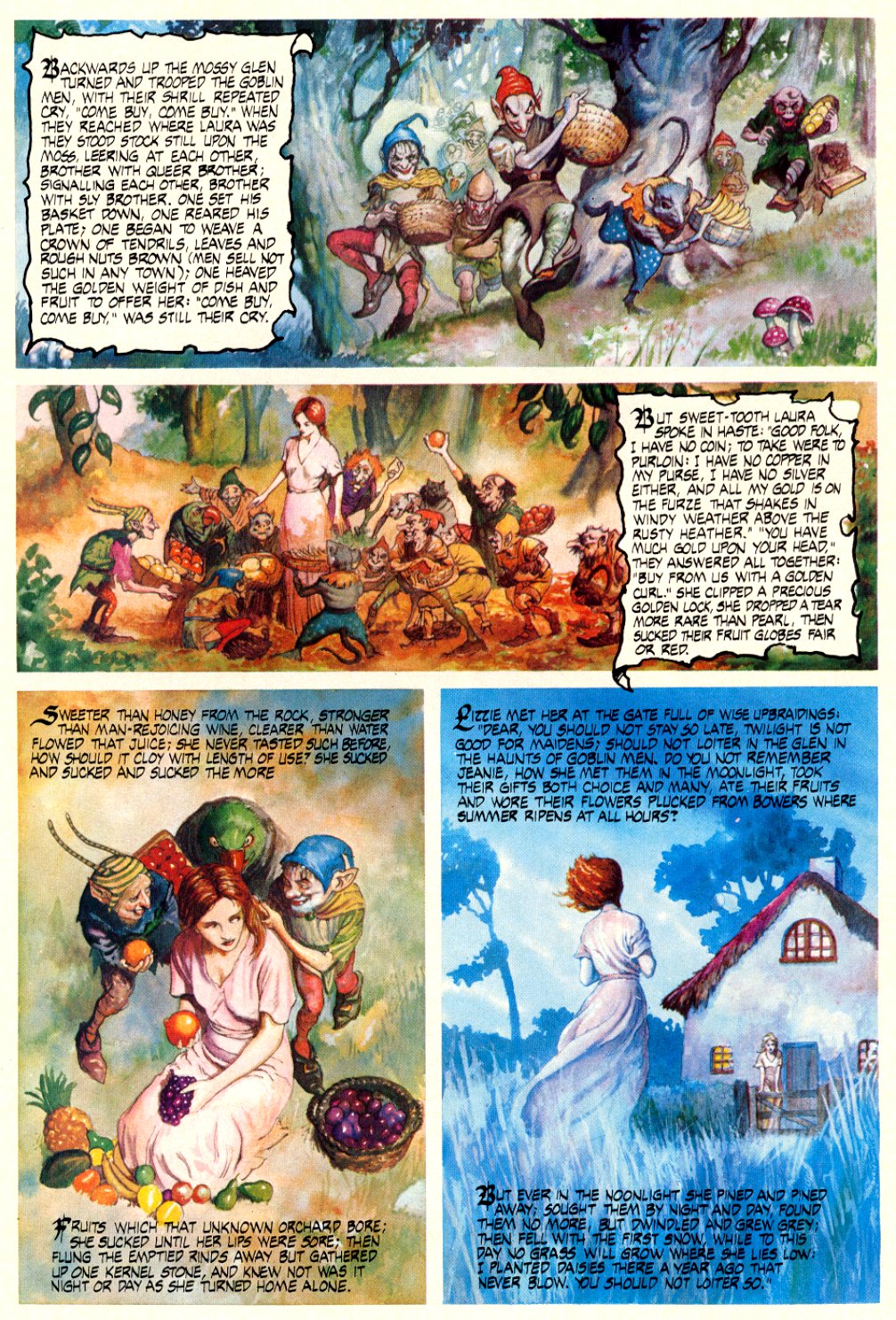


-The poem written and recited
10 Comments »
Subject :# 14214 Narrativa Inglesa desde el siglo XVIII Grupo C
Student´s name: Mengual Roca, Vanessa
Title of the paper: I wonder if time and personality are together in Six Sex Scenes. Don’t you?
Author or topic: Adrienne Eisen
Abstract: In this paper I am going to analyze the most well-known hypertext written by Adrienne Eisen: Six Sex Scenes; focusing on time and its relation with the story’s background. I have kept to this point specifically but to understand it better I am going to offer the viewer a more complete information. At first, you can read an introduction which introduce you to this paper and later you can consult a great deal of information about the authoress: Adrienne Eisen or Penelope Trunk and about the hypertext. Then, you will know all my impressions about structure and narrative tools, Six Sex Scene topics, space and time as the character’s responsible. Everything this and more will be gathered in my personal conclusion.
Bibliography, URL’s
Auto-evaluation:I think I deserve a mark of 7-8, as I have dedicated a lot of effort to go beyond a simple sex story and to look for and explain what could be interesting to the viewer.
Academic Year 2009/2010
©a.r.e.a./Dr.Vicente Forés López
©Vanessa Mengual Roca
vamenro@alumni.uv.es
No Comments »
|


 Entries (RSS)